Life lessons from landscaping


My husband and I are continuing a landscaping project we started last fall. When we initially considered this project it was  overwhelming. There was the space we had to consider as well as the aesthetic look, practical needs and our budget. How could we get the best results without exceeding our budget, or making mistakes and having to redo the landscaping? 

We had a landscape consultant helps us with the big picture. We wanted to do the planting, expanding and decorating ourselves to save on cost and to learn more about the value and skills of homeownership. 

We could then focus on priorities. This was very important because we didn’t have the time or money to do the whole project at once. 

This reminded me of man’s spiritual journey through life. If we look at ourself, our understanding, the world and all that needs to be accomplished, we might feel overwhelmed. Feeling this way often prevents us from even getting started, being apathetic or feeling like what we have to offer is of little value compared to the all that needs to be done. But as I’m learning through this landscape project – planting a tree here and there, fertilizing and watching it grow – we see how each part that we accomplish affects the whole. In fact, with each part that we accomplish we can step back, look at the big picture again, and see if any adjustments need to be made. What have we learned? Can we adjust our route or strategy?

And then we see that each part is actually a valuable, integral part of the whole. Each part is needed to help us see the full picture. And with each part we gain the ideas, lessons and skills we need to continue in a more productive, effective way. 

I think about all that the prophets and spiritual leaders have accomplished to help humanity gain a clearer sense of the allness and tangible presence of Spirit, Life, Truth and Love. They each had a spiritual journey of learning and growing – of God’s nature being revealed to their consciousness. If they had stopped, or failed to get started, we wouldn’t have the spiritual understanding of being that we do today.

Mary Baker Eddy, a Christian healer and teacher from the late 1800’s – early 1900’s wrote:

“[Divine] Science reveals the possibility of achieving all good, and sets mortals at work to discover what God has already done; but distrust of one’s ability to gain the goodness desired and to bring out better and higher results, often hampers the trial of one’s wings and ensures failure at the outset.”¹

“We must form perfect models in thought and look at them continually, or we shall never carve them out in grand and noble lives. Let unselfishness, goodness, mercy, justice, health, holiness, love — the kingdom of heaven — reign within us, and sin, disease, and death will diminish until they finally disappear.”²

Even though we have a lot of growing to do, like my garden, we can still succeed with each step we take along the way. 


¹ Mary Baker Eddy, Science and Health with Key to the Scriptures, p. 260
² Mary Baker Eddy, Science and Health with Key to the Scripturesp. 248 

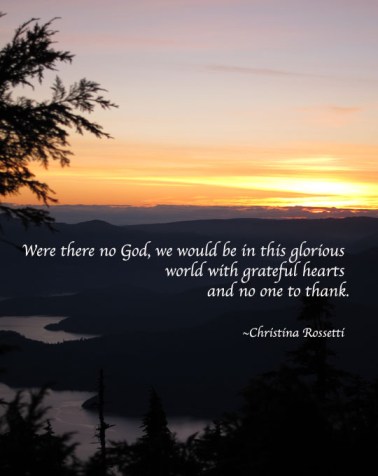
Thoughts on gratitude


I really appreciate the blog series my husband is doing right now. It is inspired by a book that we are both reading for our book club: 365 Thank Yous. It’s a wonderful story about a man/dad who is down in the dumps; his business is falling apart; his relationships with his family & friends aren’t great. One day he gets the idea (I would call this a spiritual idea, “angel” message or the Christ) which tells him to write thank you notes! It’s New Years Eve when he gets this message so he vows to write 365 thank you notes in the New Year. The rest of the book (which I haven’t finished yet) is about how this practice transforms his thought, life and relationships.

It is a delightful book. I get such a sense of joy when reading it, and it reminds me how the simple act of gratitude can really brighten my day. I may even start a “thank you” note project of my own! (My husband is doing his thank you note project on his blog.)

What is it about gratitude that makes us feel so light and joyful? It reminds us of the good in our lives and puts Good at the forefront of thought. The human mind is so prone to magnify evil or the negative. Often this mind ruminates over the past. It’s like a treadmill of worry and fear. Apparently, humans think 2,000-3,000 thoughts per day. And I’ve heard that 70% of these thoughts are the same each day. We have to jump off this same old treadmill of thought and think differently! And gratitude is a fun, light way to do that.


True love


Last night, as I was going to bed, I was praying to know how to “love my neighbor” better. 

The answer that came to me is to love my neighbor (and myself) spiritually. 

“In patient obedience to a patient God, let us labor to dissolve with the universal solvent of Love the adamant of error, — self-will, self-justification, and self-love, — which wars against spirituality and is the law of sin and death.” (Eddy, Science and Health, p. 242)

Self-will (or human wilfulness), self-justification (or feeling the need to justify what you are doing perhaps because it isn’t right) and self-love are actually the opposite of Love, divine, true Love. 

A well-known, and probably the best written statement on Love comes from I Corinthians 13:

“If I speak in the tongues of mortals and of angels, but do not have love, I am a noisy gong or a clanging cymbal. And if I have prophetic powers, and understand all mysteries and all knowledge, and if I have all faith, so as to remove mountains, but do not have love, I am nothing. If I give away all my possessions, and if I hand over my body so that I may boast, but do not have love, I gain nothing.

 Love is patient; love is kind; love is not envious or boastful or arrogant or rude. It does not insist on its own way; it is not irritable or resentful; it does not rejoice in wrongdoing, but rejoices in the truth. It bears all things, believes all things, hopes all things, endures all things.

 Love never ends. But as for prophecies, they will come to an end; as for tongues, they will cease; as for knowledge, it will come to an end. For we know only in part, and we prophesy only in part; but when the complete comes, the partial will come to an end. When I was a child, I spoke like a child, I thought like a child, I reasoned like a child; when I became an adult, I put an end to childish ways. For now we see in a mirror, dimly,but then we will see face to face. Now I know only in part; then I will know fully, even as I have been fully known. And now faith, hope, and love abide, these three; and the greatest of these is love.” (New Revised Standard Version)

I think of this wonderful statement of love as a comparison between self-love (thinking we are the best and indulging our material personality) versus spiritual love, the Love which is God itself. 

We have all felt moved, touched or inspired by Love, I’m sure. Perhaps it was in helping a friend, saying just the right thing that meant so much to someone, or in a healing we had. As we erase the “adamant of error” from our consciousness we become lighter, clearer and a better transparency for divine Love, the love that heals, saves and uplifts.